Overview
Current computational psychiatry models heavily rely on isolated biochemical parameters, obscuring the non-linear realities of topological vulnerability in the human brain. To address this, I have developed the Bioenergetic Stability Index (ISB): a deterministic, multi-scale Ordinary and Partial Differential Equation (ODE-PDE) architecture.
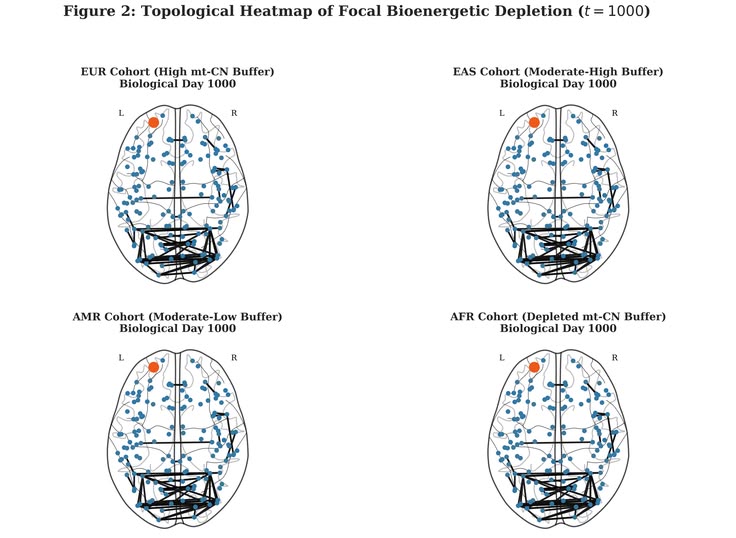
Caption: Spatiotemporal connectome map visualizing the anisotropic diffusion of metabolic stress strictly bounded by Euclidean 3D geometric distances across the 148-node Destrieux topology.
Operating strictly under thermodynamic parsimony, the neural network is initialized at a rigid steady-state (d[ATP]/dt = 0). The model integrates empirical multi-modal matrices—including the Euclidean-bounded Destrieux connectome, continuous AHBA transcriptomics, Neuromaps PET density, and pan-ancestry gnomAD data. It mathematically demonstrates that major depressive phenotypes emerge from a focal topological phase transition (a Saddle-Node Bifurcation, [ATP] < 0.5 mM) driven by cumulative allostatic load against absolute cerebral metabolic limits.
Computational Evidence & Phase Transitions
To mathematically validate this architecture, extreme stress simulations were executed across large-scale dynamic cohorts.
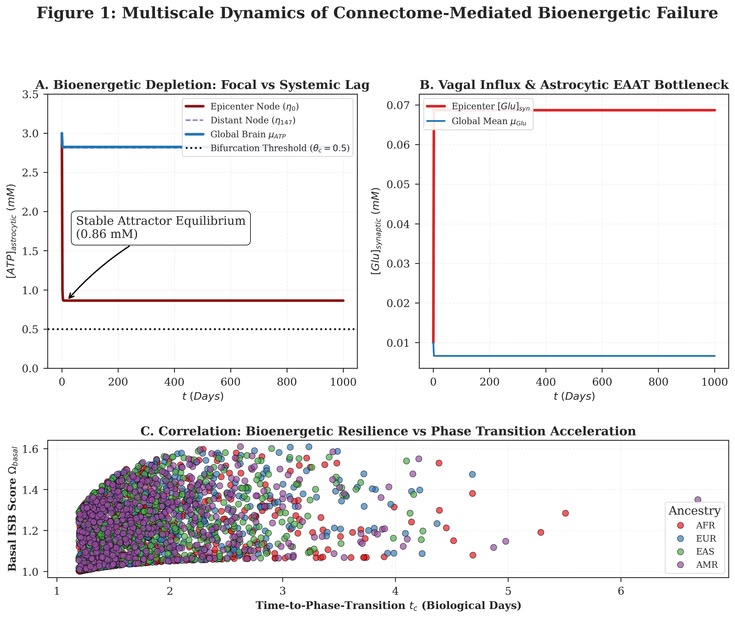
Caption: Deterministic phase-space trajectory of focal bioenergetic depletion, capturing the precise Saddle-Node Bifurcation threshold under continuous environmental stress.
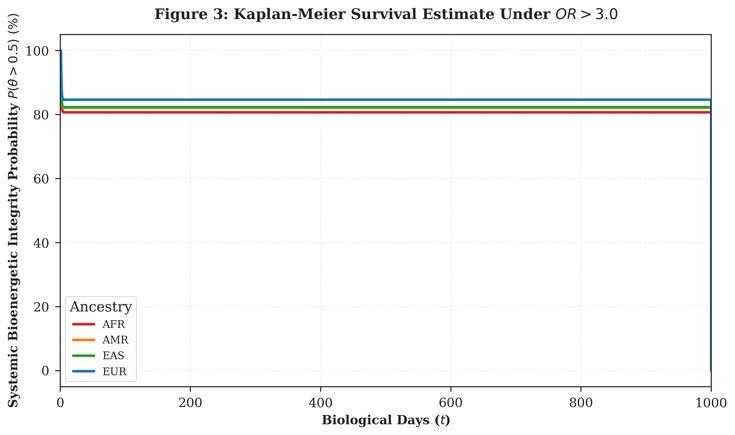
Caption: Kaplan-Meier estimates tracking systemic bioenergetic survival probabilities across diverse ancestral cohorts under extreme thermodynamic load (Odds Ratio > 3.0).
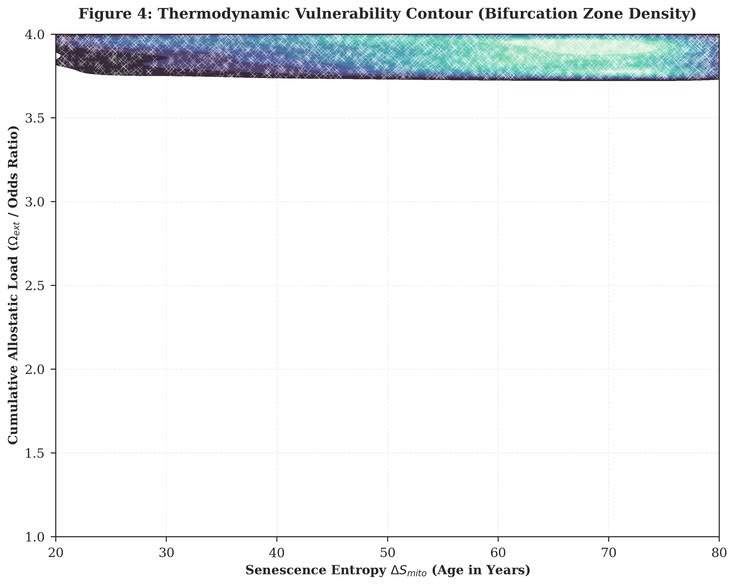
Caption: Thermodynamic contour mapping the bifurcation zone against cumulative allostatic load and chronological senescence entropy.
Traction & Current Bottleneck
As an independent researcher, I have completed the foundational ISB architecture and executed a massive Pan-Ancestry Monte Carlo ensemble (N=40,000 synthetic subjects). The full deterministic Python codebase is open-sourced on GitHub (GPL v3.0), and the V2 preprint is publicly deposited on Zenodo.
GitHub: https://github.com/cefiyana-clover/ISB_Thermodynamics_Pipeline
Zenodo: https://doi.org/10.5281/zenodo.20410094
The operational reality of this architecture is uniquely constrained: this entire mathematical pipeline, including the N=40,000 Monte Carlo execution, was engineered and run strictly from an Android mobile device utilizing the free, 2-core tier of Google Colab.
I am now advancing the model to its next evolutionary phase. I have successfully integrated 4 out of 5 advanced computational expansions:
Adaptive Neuroplasticity
Stochastic Langevin Noise (SDE)
Anisotropic Euclidean Diffusion
Blood-Brain Barrier (BBB) Filtration Delay
However, the 5th expansion—Dynamic Epigenetic Drift (RNA velocity kinetics)—and the scaling of Stochastic Differential Equations (SDE) require computational power that structurally exceeds free 2-core cloud limits. Currently, running 4,000 deterministic subjects takes ~49 minutes. Scaling stochastic models across 40,000+ subjects on free tiers results in forced runtime disconnections.
Funding Utilization (Minimum vs. Goal)
Minimum Funding ($1,500): Hardware Acquisition (Resolving Computational Bottlenecks). This will directly fund the acquisition of a dedicated local computational node (a mobile workstation with a minimum 8-core/16-thread processor, 32GB DDR5 RAM, and 1TB SSD). This hardware will immediately bypass cloud session limits, allowing continuous, multi-threaded execution of massive stochastic datasets and reducing simulation times from days to hours.
Full Funding Goal ($3,500): Cloud Scaling & Research Autonomy. Achieving the full goal will cover the hardware acquisition ($1,500) plus $500 for dedicated enterprise cloud compute credits (e.g., AWS/GCP instances for specialized PDE rendering) and $1,500 as an independent research stipend. This stipend provides the necessary operational runway to focus exclusively on securing in-vivo time-series transcriptomic data and completing the 5th expansion to finalize the ISB architecture for public release.
Why Fund This?
This project represents extremely high leverage. By funding the essential hardware for an independent researcher, you are directly enabling the advancement of a strictly rigorous, open-source computational neuroscience framework that accelerates precision psychiatry—without the overhead costs of traditional institutional academia.